DoorDash Storefront looks like your own online ordering. Read the fine print.
By Taylor Remund, founder of Plateful ·
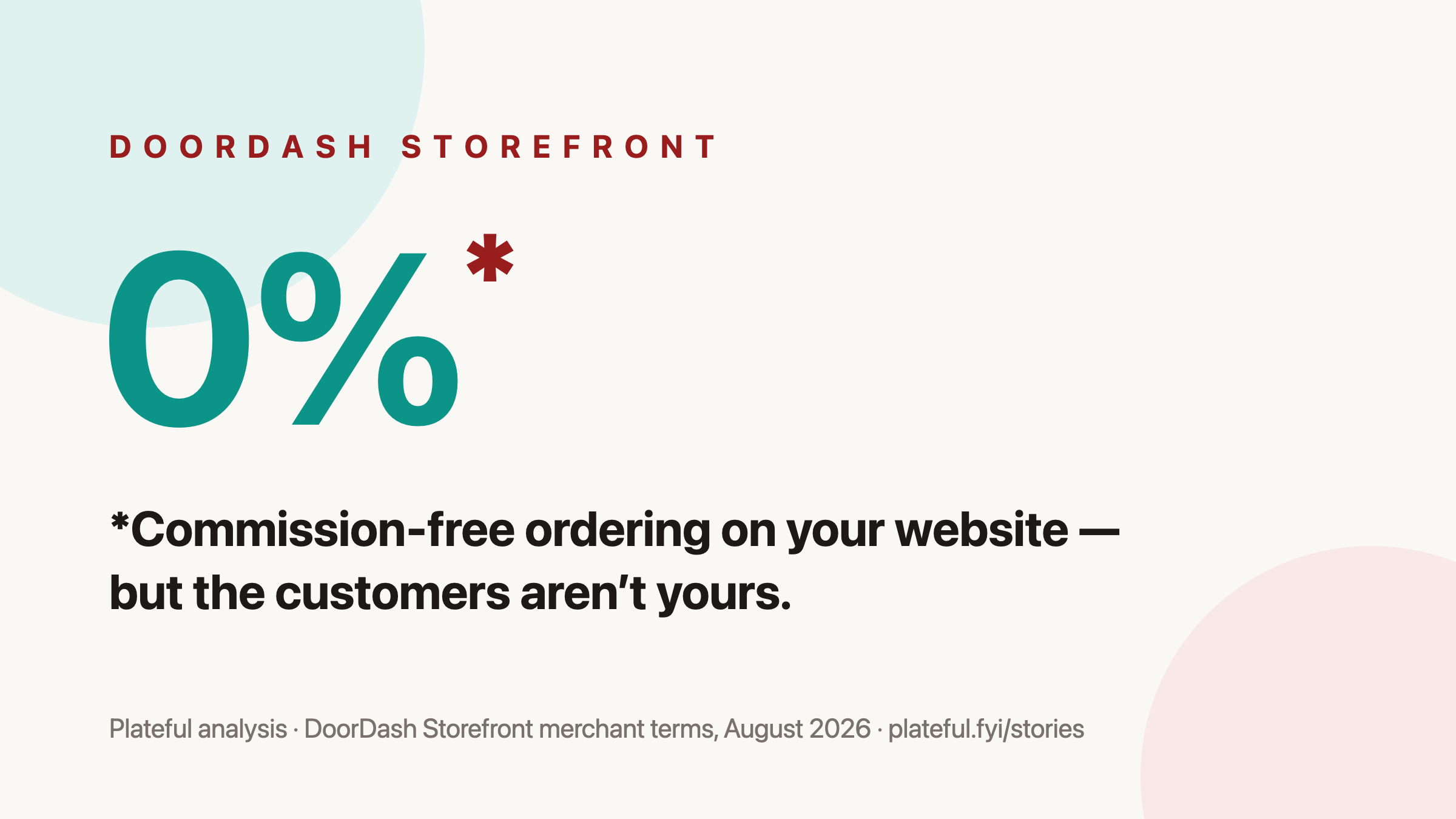
When I catalogued the Wasatch Front's independent restaurants for the ordering-gap piece, one category kept making me look twice: restaurants whose ordering looked first-party — an "Order Online" button on their own website, their own menu, their own branding — but whose button went to a page DoorDash runs, on a domain DoorDash owns. Checking websites alone, I found 39 of them. Then I verified every restaurant against the platforms directly, and the real number is 160 — nearly one in five of the corridor's independents, four times what the websites reveal. It is quietly the second-largest "own ordering" arrangement in Utah, ahead of everything except Toast.
That's DoorDash Storefront — these days marketed as "Online Ordering by DoorDash" — and it's the most interesting product in this whole space, because it's DoorDash's answer to the exact complaint I built Plateful around: the apps take too much. So let's take it seriously.
The pitch, and it's a real pitch
Storefront is commission-free. Not reduced-commission — zero. Orders placed through it skip the 15–30% marketplace commission entirely; the restaurant pays a payment-processing fee of roughly 2.9% plus 30¢ per order (3.3% on the entry package). Setup is fast, the checkout is one customers already know, and if you're currently paying 25% on every marketplace order, moving your regulars to Storefront is an enormous, immediate raise.
I want to be plainly honest here: on raw per-order cost, a Storefront pickup order is cheaper than Plateful. Plateful charges 4% of the food subtotal on top of standard Stripe processing. If per-order price were the only thing that mattered, Storefront would win that comparison, and I'd rather tell you that myself than have a DoorDash rep tell you I didn't.
So why am I writing this? Because "commission-free" is the answer to one question — what does an order cost? — and it's the wrong question to stop at. The right one is: whose channel is this?
Catch one: the customers aren't yours
This is the one that matters most, and it's not my characterization — it's the contract. DoorDash's Storefront merchant terms say the restaurant receives "sufficient information to prepare the order" but "will not own such Customer Data," and they bar the restaurant from using it for remarketing.
Read that again in plain English: a regular can order from you every Friday for a year through the ordering page on your own website, and you don't own their relationship and can't market to them. No email list, no "we miss you" offer, no loyalty program of your own. The thing that makes a direct channel worth having — the compounding value of customers you can reach — is specifically carved out.
Catch two: the address isn't yours
Every Storefront page I found in the dataset lives on DoorDash's ordering domain, not the restaurant's. Your website links out to it, the way you'd link to anything you don't control.
That sounds cosmetic. For search, it isn't. When someone Googles your restaurant's name plus "order," the page that ranks, collects the click, and builds authority over the years is DoorDash's. Menus, hours, ordering — the content that search engines treat as proof your restaurant is real and active — accrues to their domain. If you ever leave, you take none of it with you; the "order online" page for your restaurant simply stops existing.
Catch three: the terms are theirs
The marketing page says commission-free with no monthly fee, and today that's broadly true. But the contract behind it reserves a fuller fee schedule — a setup fee, a software fee, a per-order merchant fee, merchant delivery fees — whatever your particular agreement specifies. Delivery on Storefront orders is fulfilled by Dashers, with a delivery fee and service fee on your customer's side of the receipt, plus a $2 small-order fee under $10. And Storefront rides on your DoorDash partnership: the pricing, the terms, and the product's existence are decisions DoorDash makes, on DoorDash's schedule.
None of that is a scandal. It's just renting. Renting is fine — every restaurant rents something — as long as nobody tells you it's ownership.
The honest comparison
If your situation is "we're paying 25% on every online order and we have no website," Storefront is genuinely one of the better moves available to you, and I'd tell you that to your face.
What Plateful sells is the thing Storefront's contract carves out. Your storefront runs on your own domain, so every search click builds your asset. Your customers are your customers — names, emails, order history, a loyalty program that belongs to you. Payment goes straight from the diner's card to your bank account through Stripe; Plateful never holds your money. That's what the 4% is for — and tips and tax are excluded, there's no subscription, and I build the menu and storefront for you.
Cheaper rent, or a mortgage. That's the actual choice, and it deserves to be made with the fine print on the table.
If you want to see the numbers side by side for your restaurant, the savings calculator does the math with your volume, or grab 15 minutes with me and we'll read your current statement together.
Sources: DoorDash merchant pricing page and the US Storefront Product Addendum (DoorDash Help Center), both retrieved August 2026; processing rates as reported in current third-party fee guides. Storefront usage counts from my verified catalogue of 851 Wasatch Front independents (websites checked July 2026, platforms verified August 2026). If DoorDash's terms change or I've misread a clause, email me and I'll correct it.