We checked 851 Utah restaurants — twice. 56% can't take an online order of their own.
By Taylor Remund, founder of Plateful ·
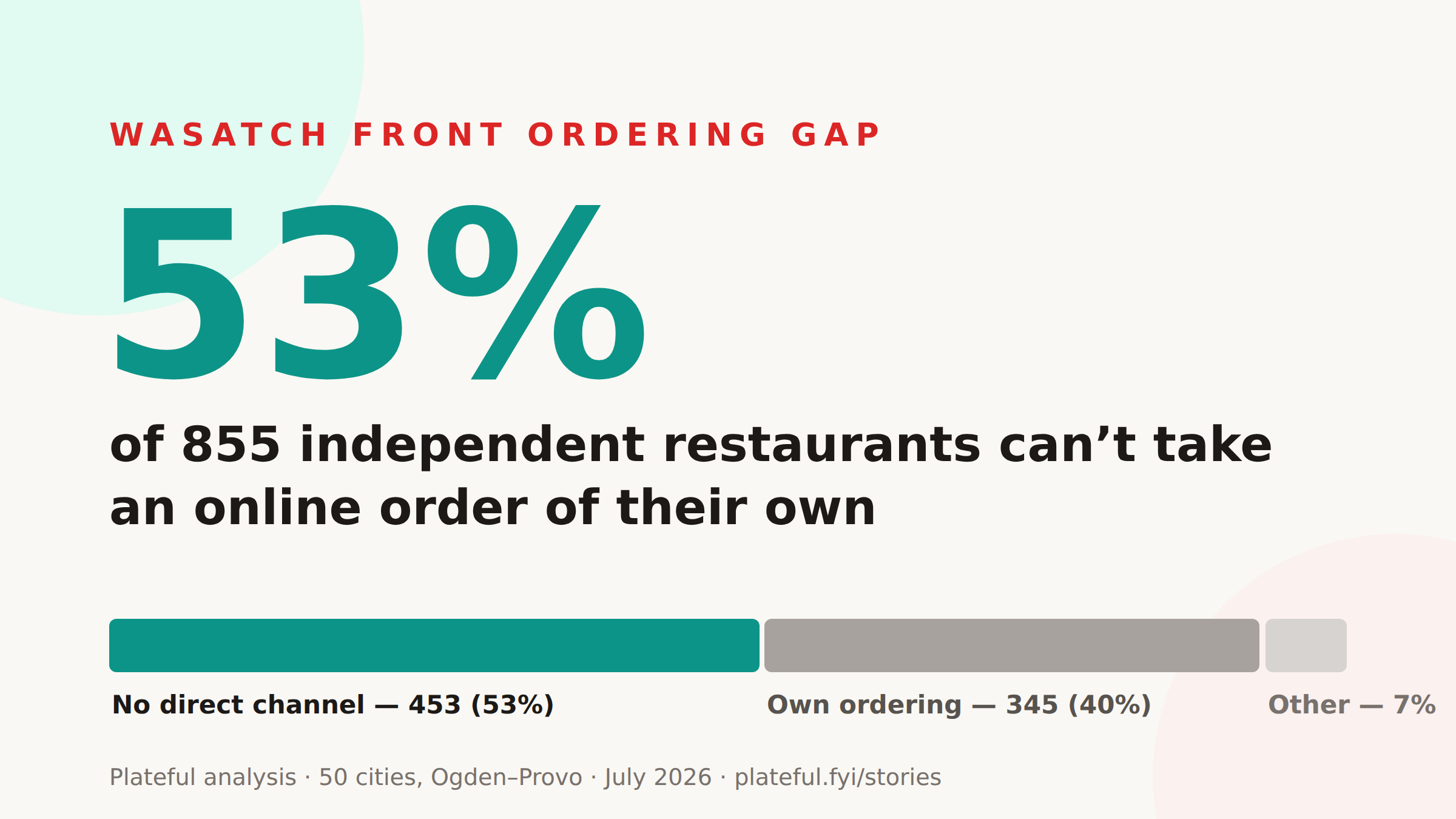
Updated August 19, 2026: this analysis originally relied on checking each restaurant's website. I've since verified every restaurant against the delivery platforms themselves — DoorDash, Uber Eats, Grubhub, order.online, and Toast-hosted pages — re-checked every site with a full rendered browser, hand-verified every restaurant that still showed no ordering anywhere, and caught four chains that had slipped my independent filter. The numbers below are the corrected ones, and the story they tell is sharper than the original. The old version's headline claim survives; most of its sub-numbers don't. Details in the methodology note at the bottom.
While I was building Plateful, I did something a little obsessive: I catalogued every independent restaurant I could find along the Wasatch Front. Not a sample — the whole corridor, from Ogden down through Salt Lake to Provo, fifty cities' worth of taquerias, pho shops, curry houses, and diners.
I wanted to answer one question with actual data instead of a hunch: how many of Utah's independent restaurants can take an online order without renting that ability from someone else?
What I did
Using Google's Places data, I searched cuisine by cuisine, city by city, for budget and mid-range ($ and $$) restaurants across the Wasatch Front. After removing chains, that left 851 independents. In July 2026 I checked every one of their websites — including the JavaScript-rendered ones a simple scrape would miss. Then in August I did what a website check can't: I searched every restaurant against the delivery platforms themselves, because a restaurant with no website can still be listed on DoorDash, and a restaurant's "own" ordering page can secretly live on DoorDash's domain. Every restaurant that still showed nothing anywhere, I verified by hand.
The finding
476 of the 851 — 56% — have no online-ordering channel of their own.
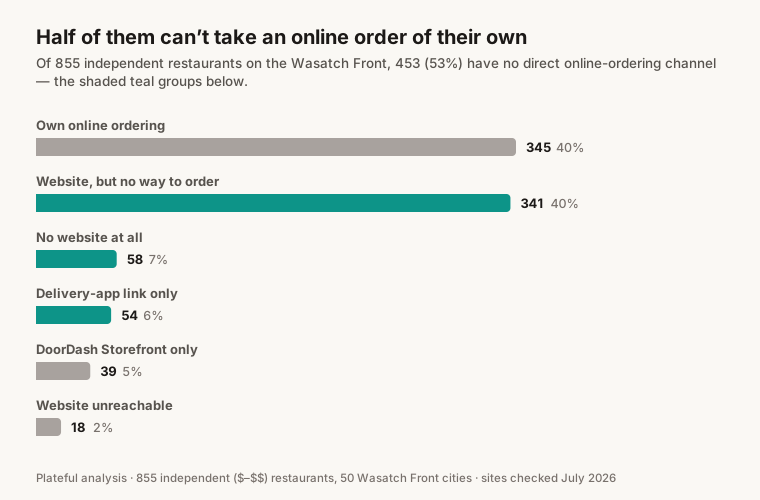
The breakdown: 310 restaurants (36%) are marketplace-only — their only online ordering is a DoorDash, Uber Eats, or Grubhub listing, at 15–30% commission per order. Another 160 (19%) run what looks like their own ordering but is actually DoorDash Storefront — hosted on DoorDash's domain, under DoorDash's terms, with DoorDash keeping the customer data. And just 6 (under 1%) have no online ordering anywhere — each one verified by hand.
On the other side, 375 restaurants (44%) genuinely run their own first-party ordering — Toast is the biggest at 155 installs, followed by Olo, Square, and Clover, with a long tail of smaller vendors down to bespoke one-off ordering sites. And 56 independents still have no website at all.
Two things in that breakdown surprised me. First, online demand is essentially universal: only 6 of 851 restaurants are truly offline — and most of those are dine-in concepts like hotpot and conveyor sushi. The gap was never about whether these kitchens sell online — they do — it's about who owns the channel. Second, DoorDash's reach is four times bigger than websites reveal: my July website check found 39 restaurants on Storefront; the platform check found 160. The most invisible commission structure on the Front is the one that looks like independence.
Here's the part that stuck with me most: these are not struggling businesses. The restaurants with no channel of their own have a median of 840 Google reviews, 96% of them have more than a hundred, and the group averages a 4.4-star rating. These are beloved, busy, established places. They're just paying rent, one order at a time, on customers they earned themselves.
The cheaper the restaurant, the bigger the gap
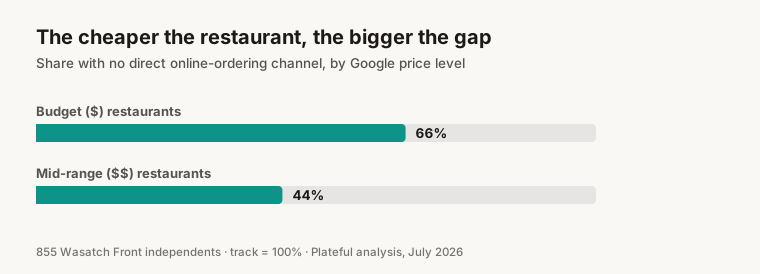
Among budget ($) restaurants, 70% have no channel of their own, versus 47% of mid-range ($$) spots. Budget kitchens are 39% of the corridor but only 27% of first-party-ordering adopters. And look at what dominates the dataset: Mexican (the largest group), Chinese, Thai, Vietnamese, Indian, Korean. The Wasatch Front's ordering gap is concentrated in exactly the kitchens least likely to have someone with spare evenings to fight with web software — the family-run places where everyone already works the line.
What the gap costs
Delivery-app commissions on marketplace orders run 15–30%. A restaurant doing $6,000 a month through the apps at 25% pays $1,500 a month — $18,000 a year.
Scaling that requires assumptions, so here are mine, conservatively: the platform check found 310 independents whose only online channel is a marketplace listing. If just half of them sell $4,000 a month through the apps at 25%, commissions take about $1.85 million a year from this one stretch of Utah. Either way: millions, annually, from independent kitchens along a single metro corridor.
To be fair to the apps: they do bring new customers, and that's genuinely worth paying for. The problem is the regulars — the customer who orders from you every week and would happily order direct if you had a direct. Paying 25% to a marketplace for a customer it didn't bring you is the expensive part.
Why I care
Full disclosure, in case the byline didn't give it away: I'm not a neutral observer. This data is why I built Plateful — online ordering that belongs to the restaurant, at a flat 4% instead of 15–30%. I started collecting these numbers as a hungry customer who couldn't find a menu, and ended up with a spreadsheet I couldn't unsee.
If you own one of these restaurants, you can see what the gap costs you specifically — plug your numbers into the savings calculator, or grab 15 minutes with me and I'll walk you through your own math.
Methodology (v2, August 2026): 965 restaurants collected via Google Places text search (cuisine × city, $–$$ price levels, 50 Wasatch Front localities), July 2026. Chains excluded by name frequency (3+ locations) plus manual flags, leaving 851 independents. Ordering channels detected in three passes: (1) each restaurant's own website, first as raw HTML, then re-checked with a fully rendered browser to catch JavaScript-injected ordering; (2) a platform-verification pass searching every restaurant — by name, shortened name, and phone number — against DoorDash, Uber Eats, Grubhub, order.online, and Toast-hosted ordering pages; (3) a manual, one-by-one verification of every restaurant that still showed no ordering anywhere, which surfaced smaller vendors (Heartland, NetWaiter, GoToEat, and others) the automated passes didn't know. "No channel of their own" counts marketplace-only listings and DoorDash-Storefront-hosted pages, per the Storefront analysis. Classification can still err on edge cases — if your restaurant is listed wrong, email me and I'll correct it.