Your regulars are the expensive part
By Taylor Remund, founder of Plateful ·
There's a customer every restaurant knows without knowing: the Friday-night regular. Same order, most weeks, for years. If she orders through a delivery app on the Plus or Premier tier, the platform takes its 25 or 30 percent this Friday, exactly like it did the Friday she first found you.
Ask what the app did to earn its cut on that order — not on a stranger's order, on hers — and the honest answer is: it processed a payment and ran some servers. The discovery it sells happened once, years ago. The commission recurs weekly, forever.
Most of your revenue is regulars
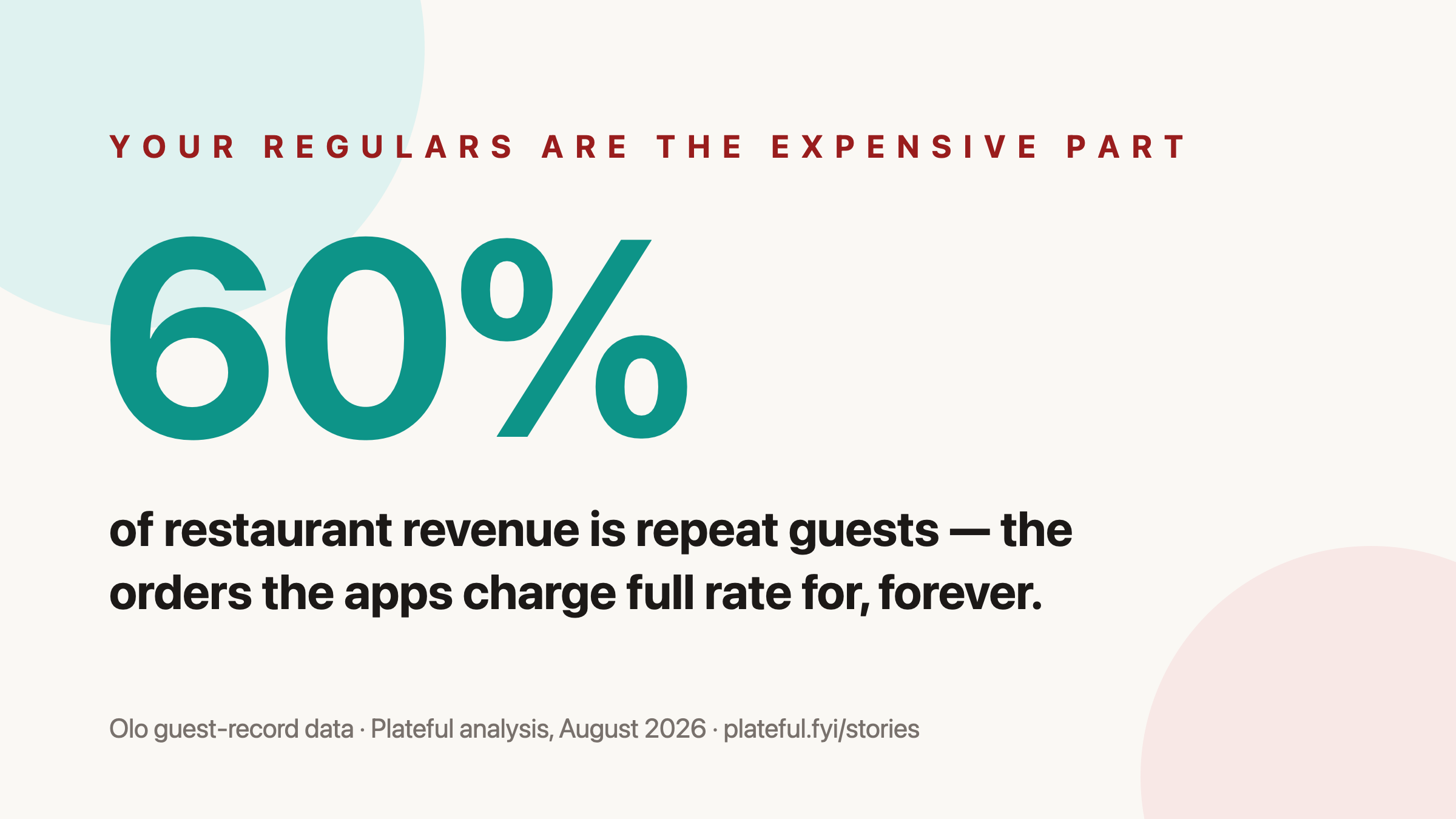
This isn't a small leak. The ordering platform Olo, looking across more than 100 million guest records, puts 60% of restaurant revenue with repeat guests. Whatever the exact number is for your restaurant, the shape is the same everywhere: most of what you sell, you sell to people who already chose you.
Marketers split spending into acquisition (winning a customer) and retention (keeping one). Acquisition is supposed to be the expensive part; retention is supposed to be cheap, because the hard work is done. Marketplace economics invert that. When your regulars order through an app, you pay acquisition-grade rates on retention-grade orders — full commission on the majority of your revenue, for customers nobody needed to acquire.
And you can't fix it from inside the app
The obvious counter is: fine, use the apps smartly — let them bring strangers, and move the regulars somewhere cheaper. The apps' terms are built precisely to make that hard.
Start with the data. You don't get your customer's email or phone number from a marketplace order — the app owns the relationship. Even DoorDash's Storefront product, the one that lives on your own website, says in its merchant terms that you get enough information to prepare the order but "will not own such Customer Data," and bars using it for remarketing. Your regular can order from you two hundred times and you have no way — none — to reach her. I wrote about that clause here.
Then the apps sell you the antidote to the problem they created. Sponsored Listings and Promotions exist so you can pay for placement in front of app users — including the ones who already order from you, and including placement your competitors can buy when someone goes looking for you. You paid full commission to serve a customer, the app kept her contact info, and now re-reaching her is a marketing line item.
And the pricing increasingly targets loyalty outright. As of this March, Uber Eats charges 30% instead of 25% on Plus-tier orders placed by Uber One members — the app's heaviest users, the people most likely to be somebody's regulars. I walked through the full rate cards here. It's a loyalty program in reverse: the more devoted the customer, the more her order costs you.
What owning the list actually buys you
Here's the un-glamorous, compounding alternative. When regulars order through a channel you own, every order deposits two things: the money, and the relationship. Name, email, order history — yours, permanently.
That changes what's possible for free. New fall menu? Email your list. Closed for a week? Tell the people who'd show up to a locked door. Slow Tuesdays? A points program handles that — on Plateful, customers earn loyalty points on every completed order automatically, and the program belongs to you, not to a platform that can reprice it in March.
None of this shows up in a per-order fee comparison, which is why I wrote this piece separately from the fee math. A commission is a cost. The customer list is an asset. A channel can be cheap per order and still leave you with nothing that compounds.
The move
To be clear about what I'm not saying: the marketplaces are genuinely good at strangers. Discovery is a real service, new customers are worth paying for, and delisting yourself in anger mostly just makes you invisible.
The move is narrower: have a direct channel, and point your regulars at it. A card in the takeout bag, a line on the receipt, a link on the Google profile — regulars want to order the way you prefer; they're regulars. The problem, as the Wasatch Front data shows, is that more than half of Utah's independents have no direct channel to point them to at all. Every week that's true, the most loyal 60% of the revenue keeps paying the new-customer tax.
If you want to see what your regulars alone would save, open the savings calculator and enter just their share of your monthly app sales — even a conservative 60% of your volume makes the point — or grab 15 minutes with me and we'll figure out your actual regular-versus-new mix from a month of statements.
Sources: Olo, "60% of restaurant sales are from repeat guests" (olo.com, retrieved August 2026); DoorDash US Storefront Product Addendum (DoorDash Help Center, retrieved August 2026); Uber Eats March 10, 2026 rate changes as reported by Restaurant Dive. If I've mischaracterized a program or a clause, email me and I'll correct it.