What a $25 order actually costs your restaurant
By Taylor Remund, founder of Plateful ·
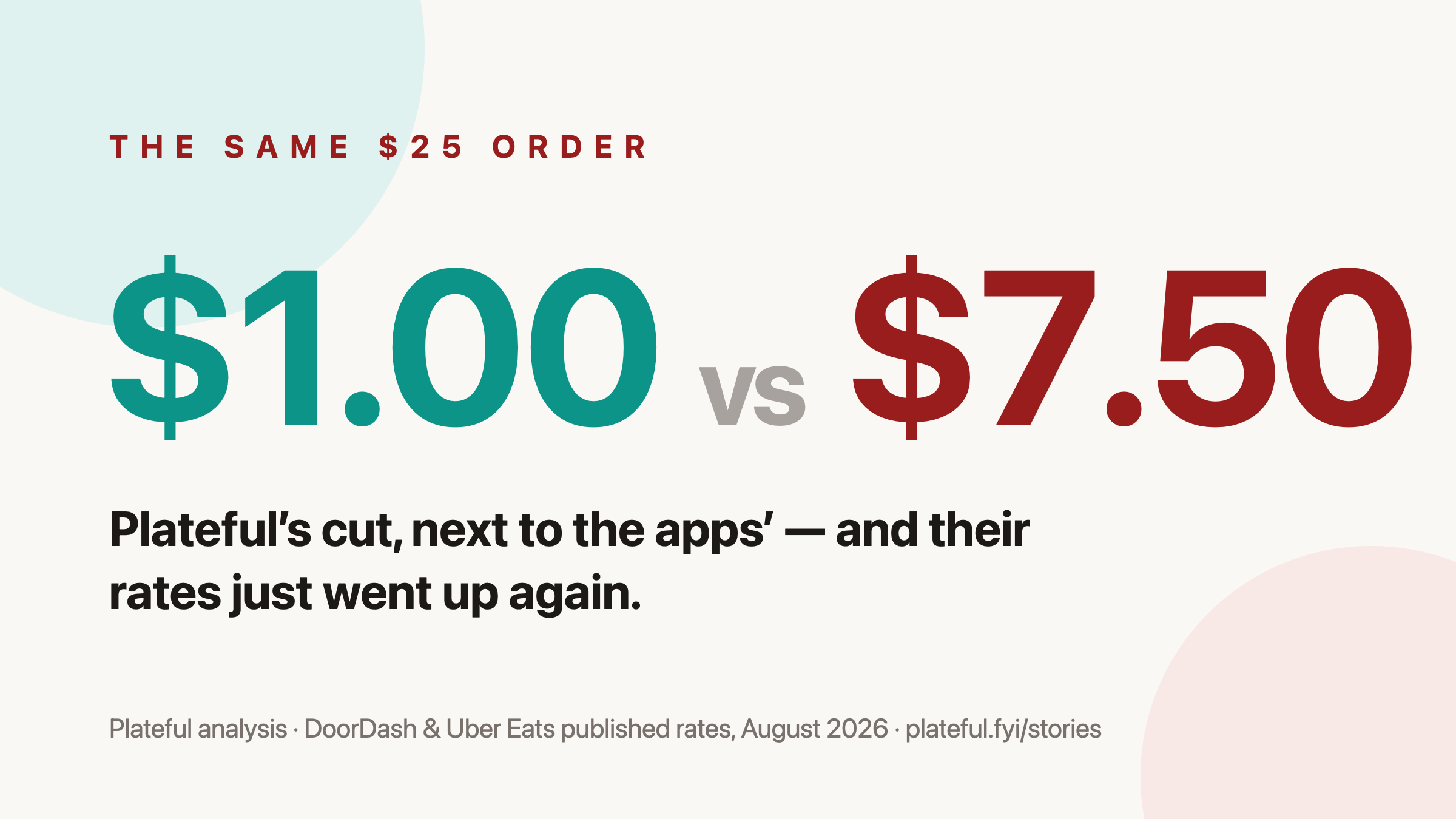
Here's an order everyone in Utah has placed: $25 of tacos. Same kitchen, same food, same hungry customer a mile away. What the restaurant actually deposits from that order depends entirely on which button the customer pushed — and the spread is wider than most owners can quote off the top of their head.
So let's do the receipts, line by line, with sources. Every number below is from the platforms' own published rate cards as of August 2026.
Ground rules
Commissions apply to the food subtotal — the $25 — before the pile of customer-side fees (service fees, delivery fees, small-order fees) that the apps add on top of the check. Those customer fees are real money too; they can add 25% or more to what your customer pays, which quietly suppresses how often they order. But this piece is about your side of the receipt.
One more thing worth knowing: marketplace commissions include payment processing. Nobody charges you 25% plus card fees — the card fees live inside the commission. Keep that in mind when we get to Plateful's math, where processing is a separate, visible line.
DoorDash: $3.75 to $7.50
DoorDash sells three marketplace tiers. On our $25 order, delivered by a Dasher:
- Basic (15%) — $3.75. The entry tier: your customers pay higher fees and you get the smallest delivery area.
- Plus (25%) — $6.25. Adds DashPass-member orders and a bigger radius.
- Premier (30%) — $7.50. The largest area, plus a "growth guarantee."
Pickup orders run 6% across all tiers. There's no monthly software fee; the commission is the product.
Uber Eats: $5.00 to $7.50 — and climbing
Uber Eats runs the same three-tier structure — and this March it raised the rates. Effective March 10, 2026: the Lite tier went from 15% to 20%, pickup went from 6% to 7%, and — this is the one to sit with — orders placed by Uber One members on the Plus tier now cost 30% instead of 25%.
On our $25 order: $5.00 on Lite, $6.25 on Plus — or $7.50 if your customer is an Uber One subscriber — and $7.50 on Premium.
Think about what that Uber One detail means. Uber One members are the app's heaviest users — the people most likely to be your regulars. The pricing now works like a loyalty program in reverse: the more devoted the customer, the bigger the cut taken from their order. Uber says the increase will help it "drive more customer demand for restaurants, courier reliability, and improved products." Maybe so. But notice the direction rates travel. In the decade these marketplaces have existed, the trend has only ever pointed one way.
Plateful: $1.00
Plateful charges 4% of the food subtotal: $1.00 on our order. Payment processing isn't hidden inside it — your customer's card is charged through Stripe at its standard rate (2.9% + 30¢, about $1.03 here), and the money lands directly in your bank account; Plateful never touches it. All in, roughly $2.03, and you keep about $22.97 of the $25.
Tips and tax are excluded from the 4%. Delivery, when you offer it, is quoted from the courier network and shown to your customer at checkout — the courier fee goes to the courier, not to Plateful. And the 4% is capped at $399 in any calendar month: past roughly $10,000 in monthly online sales, every additional order is fee-free, so your effective rate only falls as you grow.
Side by side
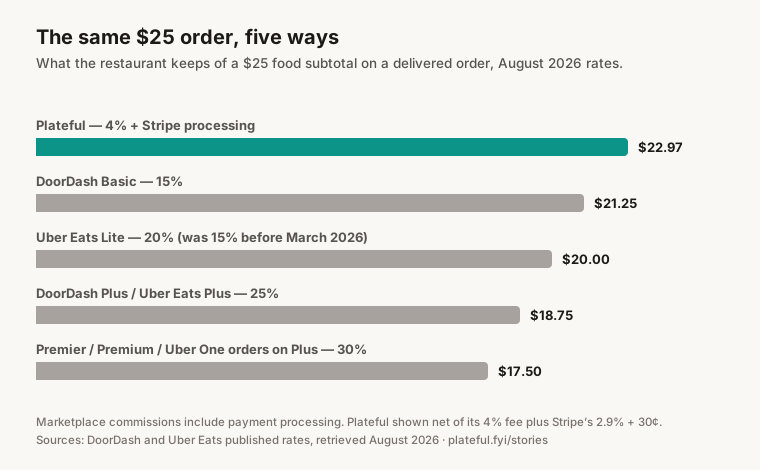
The honest footnote to this chart: DoorDash's commission-free Storefront product would keep more of a pickup order than Plateful does — about $23.97 — and I wrote a whole piece on what that arrangement actually trades away. Cheap and yours are different things.
What it adds up to
Per-order dollars feel small until you multiply. A restaurant doing $6,000 a month through the apps at 25% pays $1,500 a month — $18,000 a year. The same volume through Plateful costs $240 a month. At $12,000 a month, the marketplace bill hits $3,000 while Plateful's cap holds the fee at $399. That difference is a payroll line. For some kitchens it's the margin, full stop.
None of this means the apps are useless — they surface your restaurant to strangers, and paying for new customers is a legitimate marketing spend. The expensive part, as the numbers above show, is paying marketplace rates on the customers who already know you — more than half of Utah's independents have no direct channel to send them to at all.
Run your own numbers in the savings calculator, or grab 15 minutes with me and bring a statement — we'll walk through your actual mix of tiers, pickup, and delivery together.
Sources: DoorDash merchant pricing (merchants.doordash.com) and Uber Eats published rates, both retrieved August 2026; Uber Eats March 10, 2026 rate changes as reported by Restaurant Dive. Marketplace commissions include payment processing; Plateful's figures shown as its 4% fee plus Stripe's standard 2.9% + 30¢. If a platform changes its rates or I've gotten a number wrong, email me and I'll correct it.