What Utah's independent restaurants actually use for online ordering
By Taylor Remund, founder of Plateful ·
When I catalogued the Wasatch Front's 851 independent restaurants for the ordering-gap piece, I recorded more than whether each one could take a direct online order. For the 375 that can — verified against both their websites and the ordering platforms themselves — I recorded what they use. As far as I know, nobody has published a picture of Utah's restaurant ordering tech before, so here it is.
The map
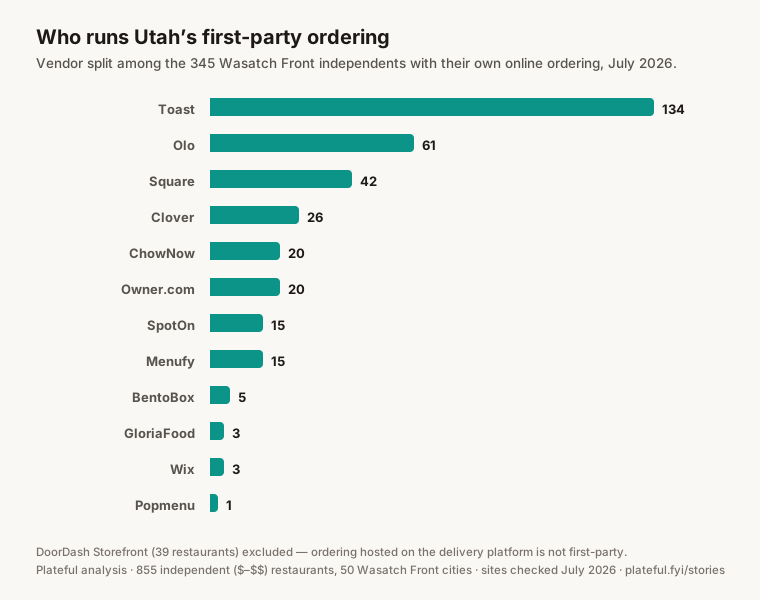
Toast towers over everything: 155 restaurants — 41% of all first-party ordering in the corridor — run on it, and 19 of those have no findable website at all; their Toast-hosted ordering page is their web presence. Add Olo's 61 and two vendors hold a majority. After that the tail scatters fast: Square (42), Clover (26), Owner.com (21), ChowNow (20), SpotOn and Menufy (15 each), then a long tail: BentoBox, GloriaFood, Wix, Popmenu, and a scattering of smaller vendors and bespoke sites (Heartland, NetWaiter, GoToEat, Joe, and one-off ordering pages) that a by-hand verification pass surfaced — proof the tail is longer than any single scan reveals.
(DoorDash Storefront's 160 restaurants aren't in this chart — ordering that lives on the delivery platform's infrastructure is its own category, not first-party. Counted anyway, it would be the corridor's second-biggest "vendor," ahead of everything but Toast.)
Four ways to buy the same thing
Twelve logos, but really four models:
Ordering attached to a POS — Toast, Square, Clover, SpotOn: 238 restaurants, nearly two-thirds of the market. Online ordering comes bundled with (or bolted onto) the register. It's a natural pairing — orders flow straight to the kitchen — and it's how Toast won Utah. The cost structure is SaaS plus hardware plus processing: Toast's POS starts around $69 a month with digital ordering running roughly another $75, before terminals and its online processing rate of 3.5% + 15¢.
Ordering specialists — Olo, ChowNow, Menufy, GloriaFood: 99 restaurants. A commission-free ordering layer that sits on the website you already have. Olo leans enterprise (it's how many multi-location groups order); ChowNow sells flat plans starting around $120 a month.
Website rebuilders — Owner.com, BentoBox, Popmenu, Wix: 30 restaurants. They replace your whole web presence — site, SEO, ordering — for a subscription; Owner.com's flat plan is $499 a month.
The delivery platform's version — Storefront, covered separately.
Notice what every first-party model has in common: a monthly bill that doesn't care how much you sell. Whether it's $120 or $700 all-in, the subscription is the price of admission, and it pays off in proportion to your online volume.
Which explains who has it
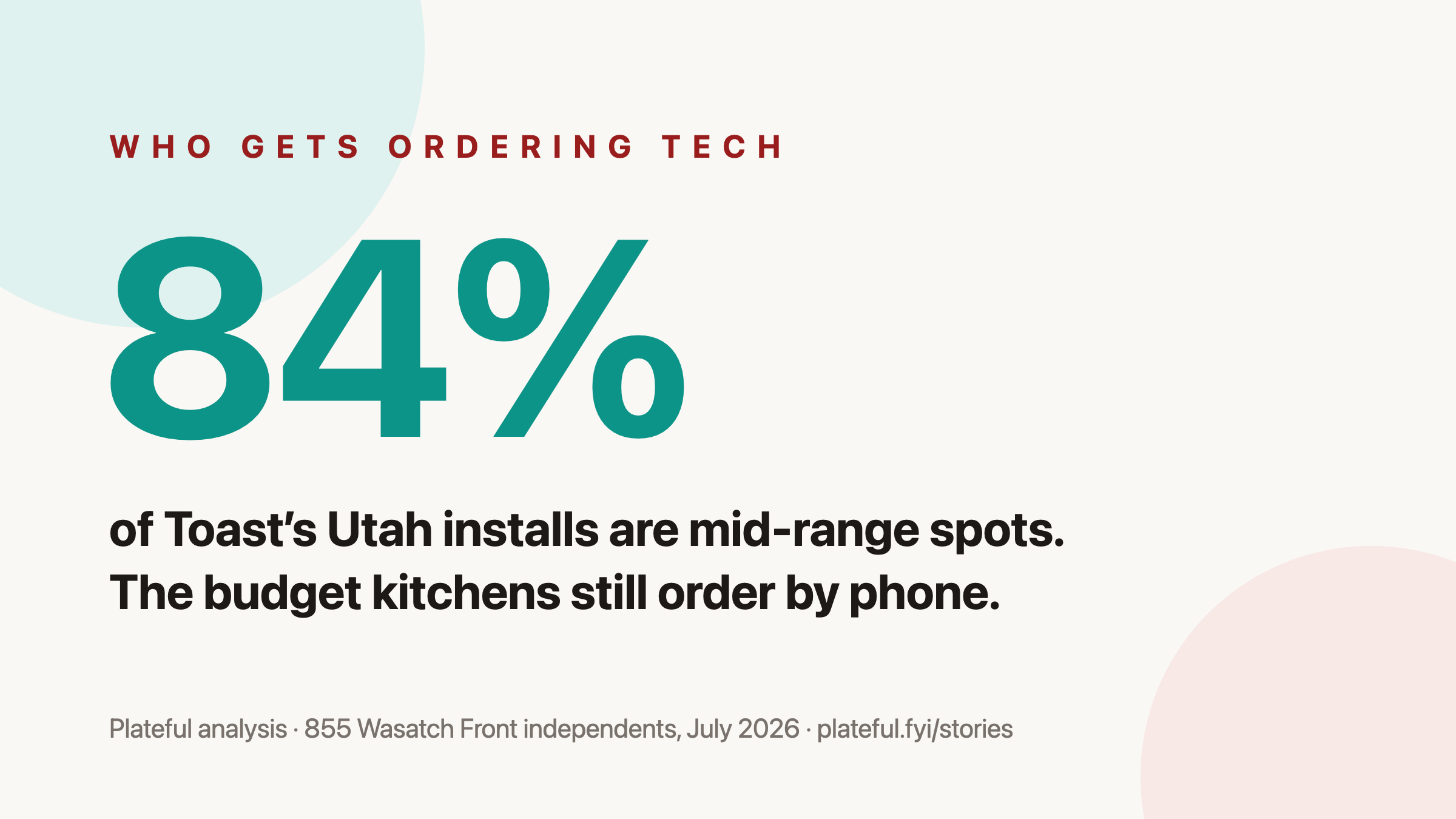
Here's the cut that makes this more than a market-share chart. Across the corridor, budget ($) restaurants are 39% of independents. Among restaurants with their own ordering, they're 27%. And at the top of the market it's starkest: only 28 of Toast's 155 Utah installs are budget restaurants — 82% are mid-range or above.
Flip it around and it's the gap piece's finding from the other side: 70% of Utah's budget independents have no direct channel at all. The tools work — 375 restaurants prove it. The pricing model is the filter. A fixed monthly bill is easy math at $15,000 a month in online orders and terrifying math at $2,000, which is exactly why the family-run taqueria with 900 Google reviews still takes orders by phone while the $$ gastropub two blocks over runs Toast.
Where Plateful fits, stated plainly
Full disclosure, as always: I sell into this market, and here's exactly where. Plateful charges no subscription — 4% of the food subtotal (the full math is here), which at $2,000 a month of online orders is $80, and at zero is zero. The model is priced for the kitchens the subscription filter screens out — and I build the menu and storefront for you, because "who has spare evenings for web software" is part of the same filter.
If you're already on Toast or ChowNow and it's earning its bill, genuinely: keep it. A restaurant with working first-party ordering is most of the way to owning its regulars already. This piece — and Plateful — is for the 476 that have nothing of their own yet.
Curious what your volume pencils out to? The savings calculator does the math, or grab 15 minutes with me.
Methodology: vendor identified from each restaurant's own website (July 2026 scan + rendered-browser recheck) and from the August 2026 platform search, which also surfaced Toast-hosted ordering pages for restaurants with no website; chains excluded by name frequency plus manual flags; price levels from Google Places. Vendor pricing from current third-party guides, retrieved August 2026 — every vendor here changes pricing periodically, so treat those figures as anchors, not quotes. If your restaurant or platform is classified wrong, email me and I'll correct it.